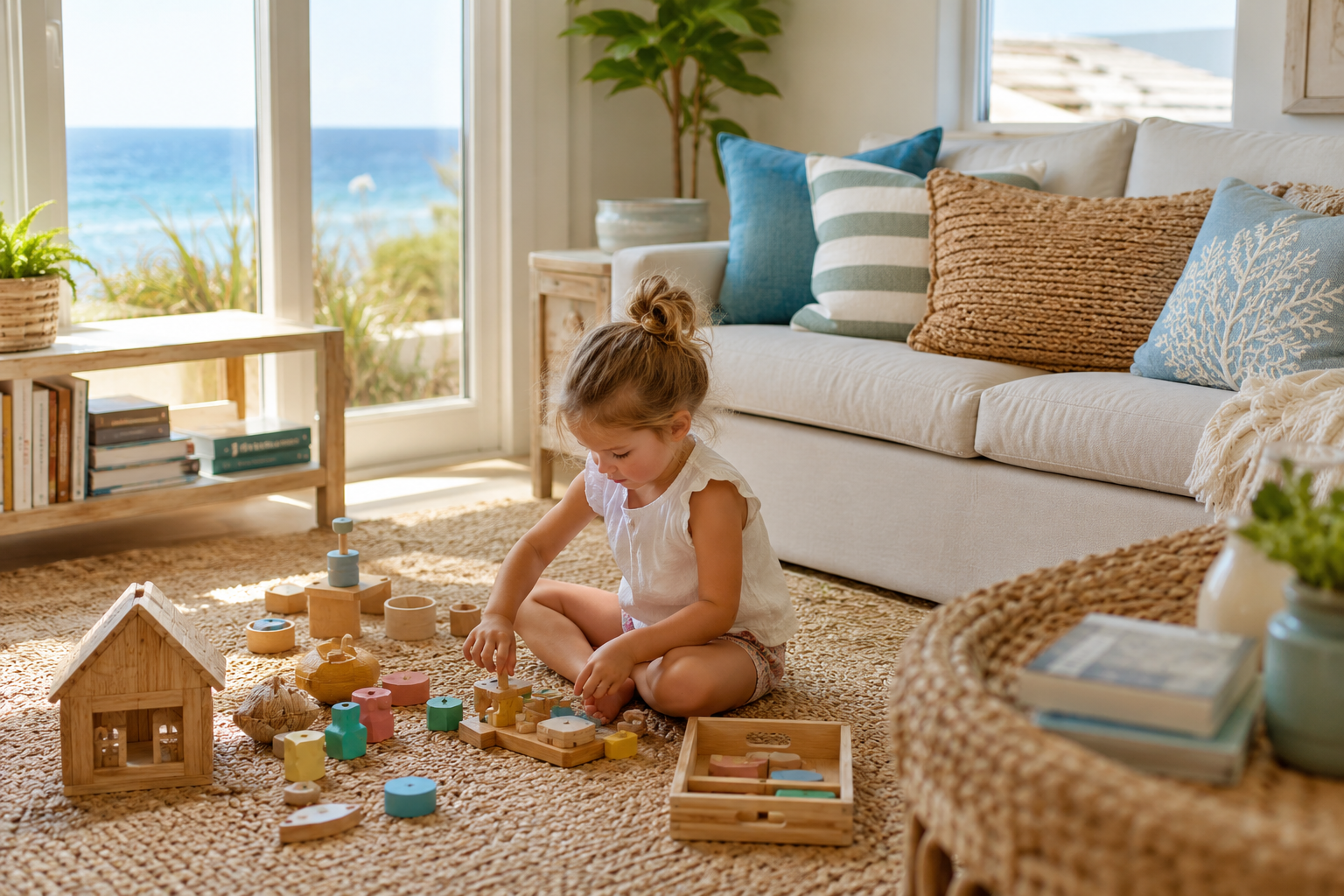
Learning how to teach kids responsibility does not require complicated reward systems, long lectures, or a perfectly organized home. Some of the most valuable lessons about responsibility happen through ordinary family life: putting toys away, carrying a plate to the kitchen, feeding a pet, sorting laundry, or helping prepare dinner.
These small jobs may not seem significant to adults, but they give children an important message: you are a capable and contributing member of this family. Instead of everything being done for them, children gradually learn that living together means everyone has a role.
For busy moms, getting children involved can also make household routines feel more shared. The first few attempts may actually take longer than doing a job yourself, but the goal is not immediate efficiency. The goal is helping children develop practical skills, confidence, and independence over time.
This approach also connects naturally with balanced parenting. Children can receive warmth and encouragement while still having clear expectations about contributing at home. Families building greater independence can also explore How to Encourage Independent Play Without Screens.
Why Chores Matter for Kids
 Household chores are about much more than keeping a room clean. They give children opportunities to practice skills they will eventually need on their own. Putting dirty clothes in a hamper, clearing dishes, organizing belongings, and helping with meals gradually turn everyday tasks into familiar habits.
The American Academy of Pediatrics explains that age-appropriate chores can teach children life skills and cooperation while helping them see themselves as contributing members of the family.
Chores can also support confidence. A child who learns, “I know how to do this,” experiences a different kind of pride than a child who simply receives praise. Competence grows through practice.
Everyday Responsibilities Can Teach Children To:
- Take care of their belongings
- Contribute to family life
- Complete simple tasks from beginning to end
- Practice patience and persistence
- Develop practical life skills
- Understand that everyone helps at home
The objective is not to turn childhood into a list of jobs. Play, rest, creativity, and family connection remain essential. Responsibilities simply become one normal part of the child’s day.
Start Earlier Than You Might Think
Young children often want to help before they are particularly good at helping. A toddler may want to carry a towel, stir ingredients, push a laundry basket, or imitate a parent cleaning a table.
Those moments can be valuable opportunities. Instead of waiting until children can perform chores perfectly, let them participate at a level that is safe and appropriate.
A preschooler may not fold towels neatly, for example, but the child can match socks or place washcloths in a drawer. A young child may spill water while helping with plants, but practice eventually makes the task easier.
Expecting imperfect results makes this process much less frustrating for everyone.
Choose Chores That Match Your Child’s Age
Children are more likely to succeed when expectations fit their developmental stage. A task that feels easy to an adult may involve several steps for a young child.
Toddlers and Preschoolers
Keep responsibilities short, concrete, and easy to demonstrate. Depending on the individual child’s abilities and supervision needs, examples may include:
- Putting toys into a basket
- Placing dirty clothes in a hamper
- Carrying napkins to the table
- Putting books back on a shelf
- Helping match socks
- Wiping a small spill with assistance
- Helping water plants
Early Elementary-Age Children
As children gain coordination and attention skills, they may be ready for responsibilities such as:
- Making their bed
- Setting or clearing the table
- Sorting laundry
- Putting clean clothes away
- Feeding a family pet
- Sweeping small areas
- Organizing school belongings
Older School-Age Children
Older children can gradually take responsibility for more involved household jobs, including:
- Helping prepare simple meals
- Loading or unloading appropriate dishwasher items
- Vacuuming
- Changing bed linens
- Preparing simple snacks
- Putting groceries away
- Taking greater responsibility for their own rooms
Age alone should not determine the exact task. Consider your child’s coordination, maturity, attention, and individual abilities, and provide supervision whenever a task involves potential hazards.
Make Chores Part of the Routine
 Children often resist responsibilities less when chores are predictable rather than randomly assigned. If toys are always put away before dinner, cleanup eventually becomes part of the transition rather than a surprise demand.
The Centers for Disease Control and Prevention emphasizes consistency, predictability, and follow-through when establishing routines and rules for young children.
You can connect responsibilities to activities that already happen every day:
- After waking up: straighten bedding
- After getting dressed: put pajamas away
- After play: return toys to their baskets
- Before dinner: help set the table
- After dinner: carry appropriate dishes to the kitchen
- Before bedtime: place dirty clothes in the hamper
This approach is sometimes easier than maintaining a complicated schedule because one familiar activity becomes the cue for the next.
For ideas on making the end of the day more predictable, see Realistic Evening Routines for Moms With Young Kids.
Teach the Chore Before Expecting Independence
Adults sometimes forget how many steps are hidden inside a seemingly simple task. “Clean your room” could mean picking up blocks, returning books, putting clothes in the hamper, arranging stuffed animals, and throwing away scraps of paper.
A young child may hear the instruction but have no idea where to begin.
Use the Show, Help, Step Back Approach
First, demonstrate the task. Next, do it together. Finally, gradually step back as your child becomes more capable.
If the job is setting the table, show where each item belongs. The next day, complete part of the task together. Eventually, allow your child to handle the appropriate items independently.
This process takes patience, but it turns vague expectations into skills children actually understand.
Keep Instructions Simple and Specific
“Clean everything up” may feel overwhelming. “Please put the blocks in the blue basket” gives a child a clear starting point.
Once that step is finished, you can give the next instruction. As children become more experienced, they may be able to remember several steps without assistance.
Instead of Saying:
“Your room is a mess. Go clean it.”
Try:
“Let’s start with the books. Put them back on the shelf, and then we’ll do the blocks.”
Clear instructions can reduce frustration for both parent and child without removing the expectation.
Avoid Redoing Every Imperfect Chore
This can be difficult for parents. A child makes the bed and the blanket is crooked. Towels are folded into unusual shapes. Toys are technically inside the basket but certainly not organized.
If an adult immediately redoes everything, the unintended message may be that the child’s effort was not good enough.
Safety and hygiene standards still matter, of course, but not every job needs adult-level precision. When possible, recognize the effort and allow children to improve naturally through repetition.
Praise the Process
Instead of focusing only on whether the result looks perfect, notice specific effort:
- “You remembered to put your plate away without being asked.”
- “You kept working even when those towels were difficult to fold.”
- “You and your brother cleaned the blocks together.”
Specific feedback helps children understand exactly what they did successfully.
Should Kids Receive an Allowance for Chores?
Families take different approaches to allowances, and there is no single system that works for every household. Some parents connect certain chores with an allowance. Others consider basic household responsibilities part of family membership while offering money for optional extra jobs.
The AAP notes that families may consider tangible rewards such as allowances or stickers in connection with completed chores, while also emphasizing consistency, encouragement, and realistic expectations.
A blended approach might mean that children are expected to put away their own belongings and clear dishes because those are normal responsibilities. Additional jobs, such as helping wash a car or completing an extra yard task, could potentially earn money.
Whatever system you choose, explain it clearly so children understand what is expected and what, if anything, earns a reward.
Don’t Turn Every Chore Into a Battle
Children will sometimes complain, procrastinate, or say they do not want to help. That does not mean the entire system is failing.
Stay matter-of-fact. You do not need to convince a child that putting laundry away is exciting.
You might say, “I know you’d rather keep playing. Clothes need to be put away first, and then you can go back to your game.”
This is another place where balanced parenting can be useful: acknowledge the feeling while keeping a reasonable expectation in place.
Use Chores to Share Family Life, Not Just Reduce Your Work
There is an understandable temptation to think of children’s chores mainly as a way to make a parent’s workload smaller. Over time, they may help. But teaching children new skills initially requires supervision, reminders, and patience.
The larger benefit is creating a family culture in which caring for the home is shared rather than invisible.
This issue is especially relevant for mothers. A 2026 Pew Research Center survey of U.S. working parents found that in different-sex couples where both parents work full time, 52% said mothers handle more of the day-to-day parenting tasks and 43% said mothers handle more household chores.
Children cannot solve an unequal adult workload, and they should never be expected to carry adult responsibilities. However, age-appropriate participation can teach them from an early age that household work is something family members notice and share.
Make Responsibilities Easier to Remember
Constant reminders can become exhausting for parents and frustrating for kids. Creating visible cues may reduce how often you need to repeat yourself.
Try a Simple Visual Chore Routine
For younger children, use pictures rather than long written instructions. A morning chart might show a bed, toothbrush, clothes, breakfast bowl, and backpack.
For older children, a short checklist on the refrigerator may be enough.
Keep the system simple. If a chore chart requires more work from Mom than the chores themselves, it probably needs to be simplified.
Let Kids Help With Real Family Tasks
Children do not always need specially invented jobs. Some of the most meaningful responsibilities come from participating in what the family is already doing.
If you are preparing dinner, a child might rinse vegetables, carry napkins, or mix safe ingredients. During laundry, children can sort light and dark clothing or match socks. Before a family beach outing, they can help collect towels, refill water bottles, or gather appropriate toys.
For coastal families, this can extend beyond the house. After a beach day, children can shake sand from appropriate gear, put toys into a beach basket, and place towels in the laundry area. Your Beach Day Essentials: A Mom’s Guide to Stress-Free Coastal Outings offers a natural companion read for families creating smoother outing routines.
Protect Time for Play and Connection
Responsibility should not consume childhood. Children still need plenty of time for imaginative play, outdoor movement, reading, friendships, and simply being with family.
That balance matters to parents as well. A 2026 national survey of parents with young children found that 72% said they wanted more quality time with their children.
Chores can actually become opportunities for connection when adults resist the urge to rush. Fold laundry while talking about the day. Prepare dinner together. Put on music during cleanup. Water outdoor plants before taking a walk.
If your child is learning to entertain themselves during quieter parts of the day, How to Encourage Independent Play Without Screens offers additional ideas for creating a healthy balance between family participation and independent time.
What to Do When a Chore System Stops Working
Family routines need to change as children grow. A task that once felt exciting may become too easy, while a new school schedule may make another responsibility unrealistic.
Instead of abandoning chores entirely, review the system occasionally.
Ask Yourself:
- Is this chore still appropriate for my child’s abilities?
- Does my child clearly understand what “finished” means?
- Are there too many responsibilities at once?
- Does the task happen at a predictable time?
- Am I expecting perfection rather than progress?
- Could my child take on a new responsibility now?
Older children can participate in these conversations. Asking, “Which job would you rather be responsible for this month?” gives them some ownership without eliminating the expectation that they contribute.
Responsibility Grows One Small Habit at a Time
Teaching responsibility is a long process. A preschooler who carries napkins to the table today may become the school-age child who prepares their backpack independently and eventually the teenager who can cook a simple meal, manage laundry, and contribute meaningfully at home.
Those skills develop through hundreds of ordinary repetitions rather than one major lesson.
There will be forgotten chores, messy attempts, reminders, and occasional resistance. That is part of learning. Consistency matters more than creating a perfect household system.
Final Thoughts
Learning how to teach kids responsibility begins with giving children genuine opportunities to contribute. Start with one or two tasks that fit your child’s age and abilities. Demonstrate what to do, practice together, and gradually step back as confidence grows.
Keep expectations clear but realistic. A five-year-old’s folded towel will not look like yours, and that is okay. What matters is that children begin to recognize themselves as capable people who can care for their belongings, help others, and contribute to family life.
Over time, those simple routines can grow into valuable life skills while also creating a home where responsibility feels shared rather than something one person quietly carries.
For more practical family ideas, explore the Seaside Moms Blog, browse Family Life, or visit Mom Life for more ways to create calmer, more connected everyday routines.